Thursday, June 4, 2026
On the 29th and 30th of May, Sallux held her annual General Members Assembly (GMA) and her annual Salt & Light event, this time in cooperation with the St. Benedict Foundation from Poland. In the GMA normally the day-to-day business of a European thinktank are discussed. For example, our work as the thinktank for the European Christian Political Party (ECPP). Also, the projects of the last year organized with our memberorganisations were presented by our director, Johannes de Jong. The next day, we held an event with the theme: "Are we moving towards a more relational Europe?" Johannes de Jong held a presentation about the Western European mindset of the nineties. He also discussed briefly the broad history of Western European countries. The statement accented by Rafal Staniszewski of the St. Benedict Foundation during his presentation "Are we moving towards a more relational Europe?" was that perceptions in stead of facts are forming relationships. After a brief historical oversight, in which Mr. Staniszewski said that their are a lot of common historic ties in Central Eastern European countries before the start of the communist ruling. The generations now living, he stated their common heritage is most of the time "communism". Then he began the core of his presentation, with referring to 2004, which was the year a large number of Central Eastern European countries joined the European Union. For him, it is clear 2004 was not an evolution, but a revolution. What was the mindset of the new countries joining the EU? When you were an Eastern European in 2004, your common thought was, according to Mr. Staniszewski through the experience of decades of communist domination, although a bit exaggerated, in the Western European countries everything is better, e.g. think of the better economy or infrastructure. Mr. Staniszewski explained, it went that far that it could be said (as it also was said then) that the Central Eastern European countries were 'selfcolonizing'. Therefore, in the beginning of the European adventure for Central Eastern European countries, the political elite, jounalists and opinion makers (most of time left-wing liberals, remarkably) were convinced: we should copy-paste the Western solutions, because of a deep sense of not being capable of for example shape a thriving free market economy. In fact, some of this expectations were not too farfetched. Because of Quality Majority Voting (QMV) Central Eastern European countries were not able to outpass in votes, greater countries Germany and France, also not in cooperation. Luckily market competition did help the Central Eastern European countries economies further. However, because of the "glass ceiling" effect, toppositions in the European Union were not available or open for Eastern or Central Europeans, for approximately 15 years, which caused an uncerntainty by CEE country people, who asked themselves the question; "Are we really not ready now to fulfill this position or is this indirect discrimination?" To wrap up about joined economies, Mr. Staniszewski coined the known line "We are the Assembly Line of the European Union". To top it all off, Western European countries did not take - think of the Nordstream project - our concerns, based on factual situations, about the Russian threat seriously. However, after 22 years of European co-existence in the European Union, the situation, Central Eastern European, afterwards seen, did far better than expected. Therefore, we as Central Eastern European countries should take some or all of the following steps, to take the initiative. Luckily, younger generations does not have any very firm ideas of the diffferences between diverse parts of Europe, so the situation is heading into a positive direction. Although, to spead up the process of working together in Europe in a relational way, the following initiatives are recommended by Mr. Staniszewski. - Expert diplomacy in stead of diplomacy of emotions (by Central Eastern European countries) - Avoid building argumentation based on history or morality. - Act before EU initiatives - Infiltration of EU institutions - Alliances with Southern/Scandianavian countries - Specialization in niche areas (become an advisor and not a client) - Positive pro-life movements that effecively shape public opinion Etc. The moral of the presentation of Mr. Rafal Staniszewski was that an open, relational way of communicating based on facts and christian way of living is the way forward. In fact, "Yes, we can!" Afterwards, a panel discussion was set up by David Fieldsend, Christoph Foltzenlogel, Javier Lopez Otero and Koloman Brenner. Javier Lopez Otero held an interesting presentation about the economical relations of the European Union with the Southern European countries. He did different proposals for a "relational way" of cooperation. (See the photo below.) As Sallux, we want to thank the St. Benedict Foundation for their efforts and enthusiasm in organizing this two days together!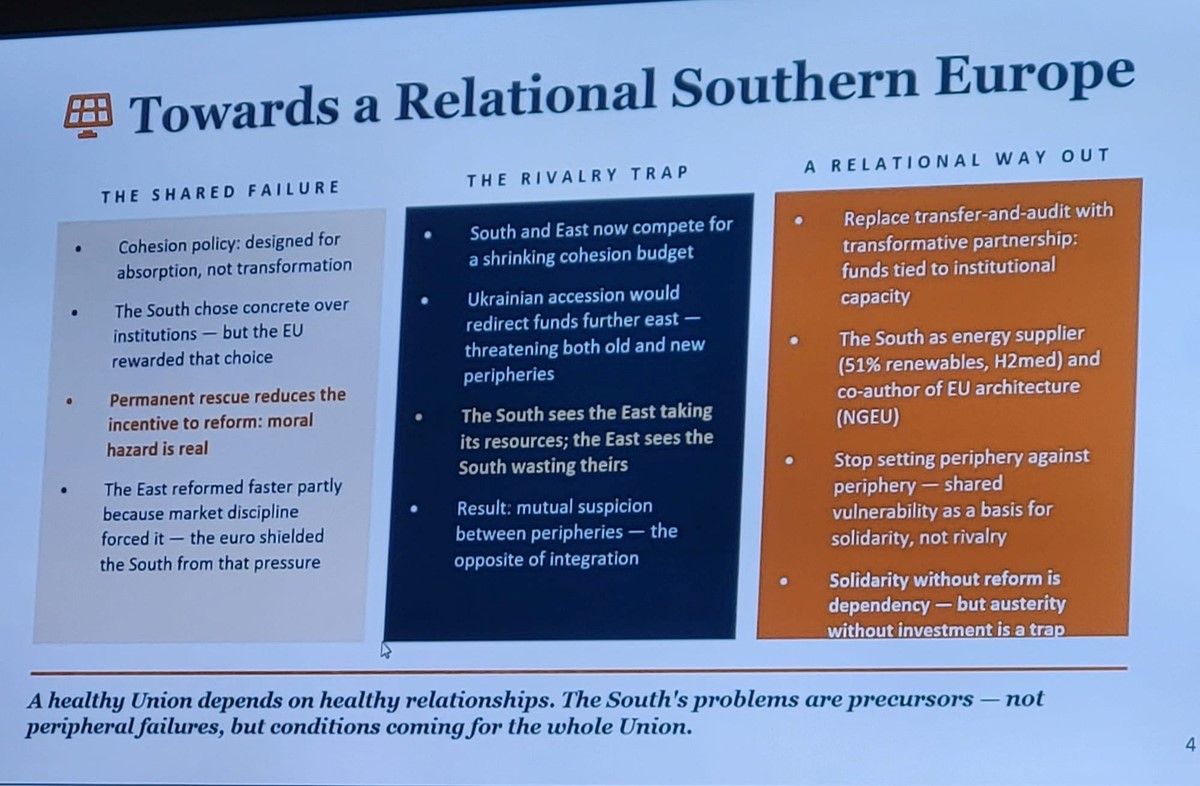 Finishing presentation slide of Javier Lopez Otero.